
Compare your complex chromatograms in 1 second.
Chromatograms of fragrances, flavours, essential oils and other complex mixtures drift as your column ages.
Based on neural algorithms, the software automatically finds many common peaks to build its matching equations, dramatically improving the quality and speed of your quality control.
With your FID, UV or MS detector (in scan mode).
Request a demoWatch more demo videosSarah, perfumer analyst: a true quality control story with GC-LC Concordance.
What GC-LC Concordance brings you
- 1 second of automatic computation, instead of 30 minutes of manual peak matching
- 1000 peaks at once: complex products, mixtures, fragrances
- No mass spectrometer required: works with your existing FID, UV or other detector
- Compatible with every CDS: Agilent, Waters, Thermo, Shimadzu, PerkinElmer
Use cases in fragrance, flavours and essential oils
- Quality control of complex fragrances (more than 200 components), batch after batch
- Essential oil authentication (lavender, rose, vetiver, ylang-ylang…)
- Detection of the 81 EU allergens (Regulation 1223/2009) in cosmetic products
- Raw material monitoring, batch to batch, to detect supplier drift
- Compliance with internal or regulatory standards (ISO, AFNOR, pharmacopoeias)
- Comparison with thousands of reference chromatograms (in-house or commercial libraries)
Also used in petrochemistry, pharmaceuticals, wine, environmental analysis and proteomics.
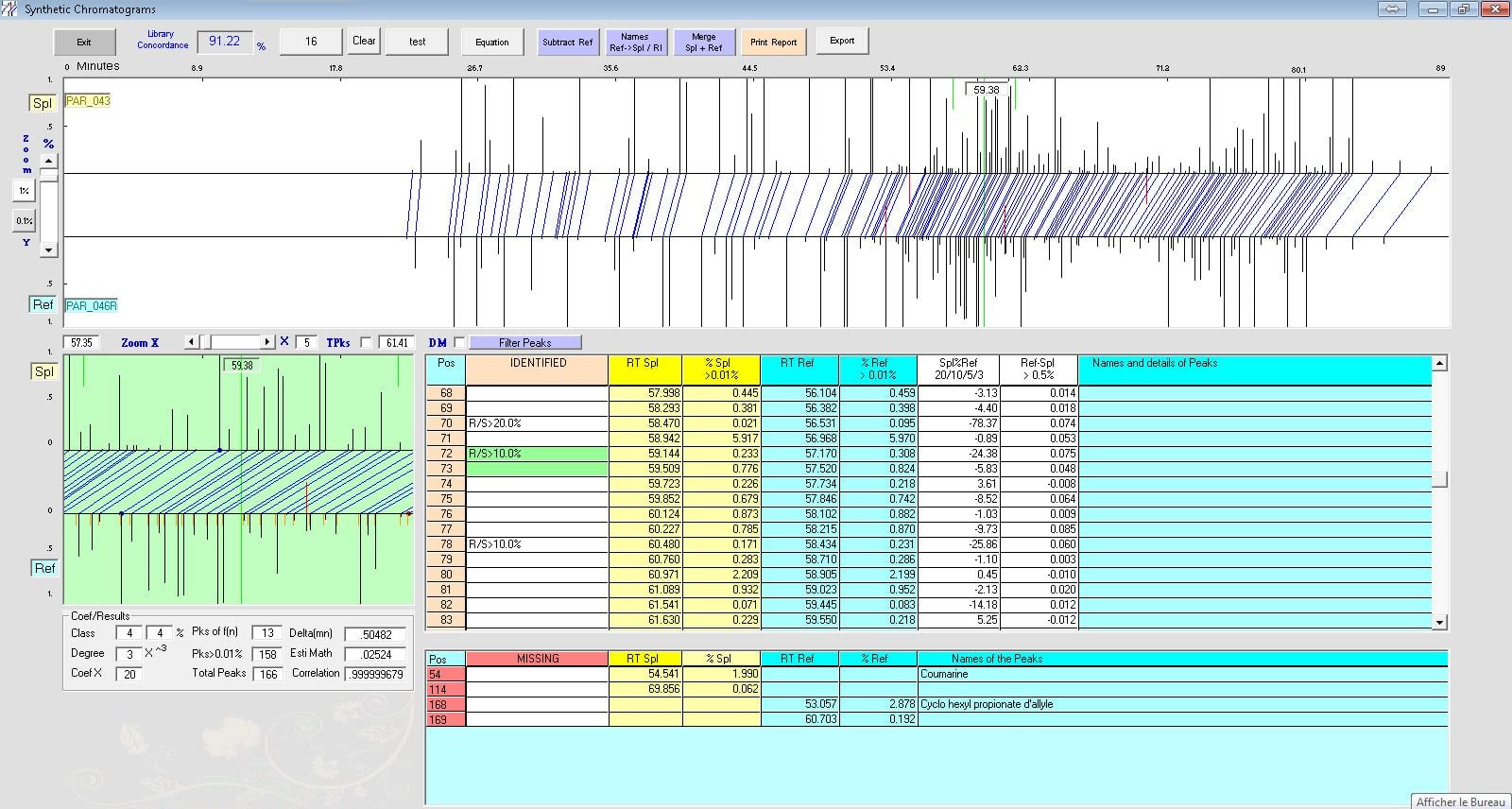
Even with a 3-minute shift between two injections, GC-LC Concordance automatically matches the peaks and compares the chromatograms.
They use GC-LC Concordance














How does it work?
In chromatography, the retention times of the components of the same injected product are not constant over time. These random variations (non-linear, unpredictable) come from the ageing of column phases, the environment and the equipment in general. A simple machine learning model therefore cannot be applied.
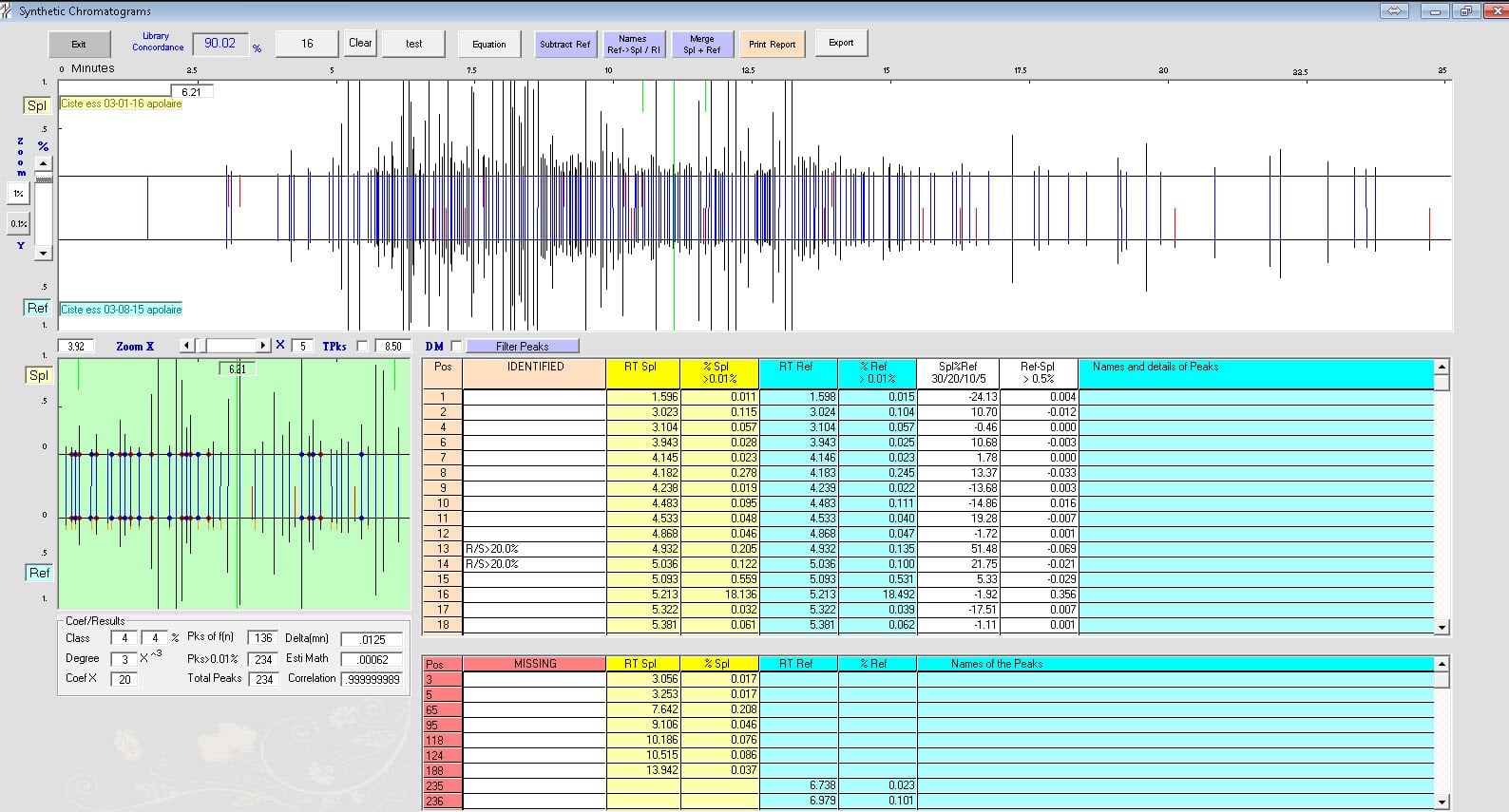
Comparison of two essence batches on a non-polar column (2015 vs 2016): 234 peaks matched automatically, 90.02 % concordance.
Only an original treatment, combining the theories of deductive mathematics of polynomial functions and neural network algorithms (recognition and adaptability), can resolve these random variations, with modern computing power (up to 100 million calculations per comparison).
The result: GC-LC Concordance automates, in a few seconds, the comparison of complex chromatograms with tens or hundreds of peaks, against one reference chromatogram or against thousands of chromatograms in a library.
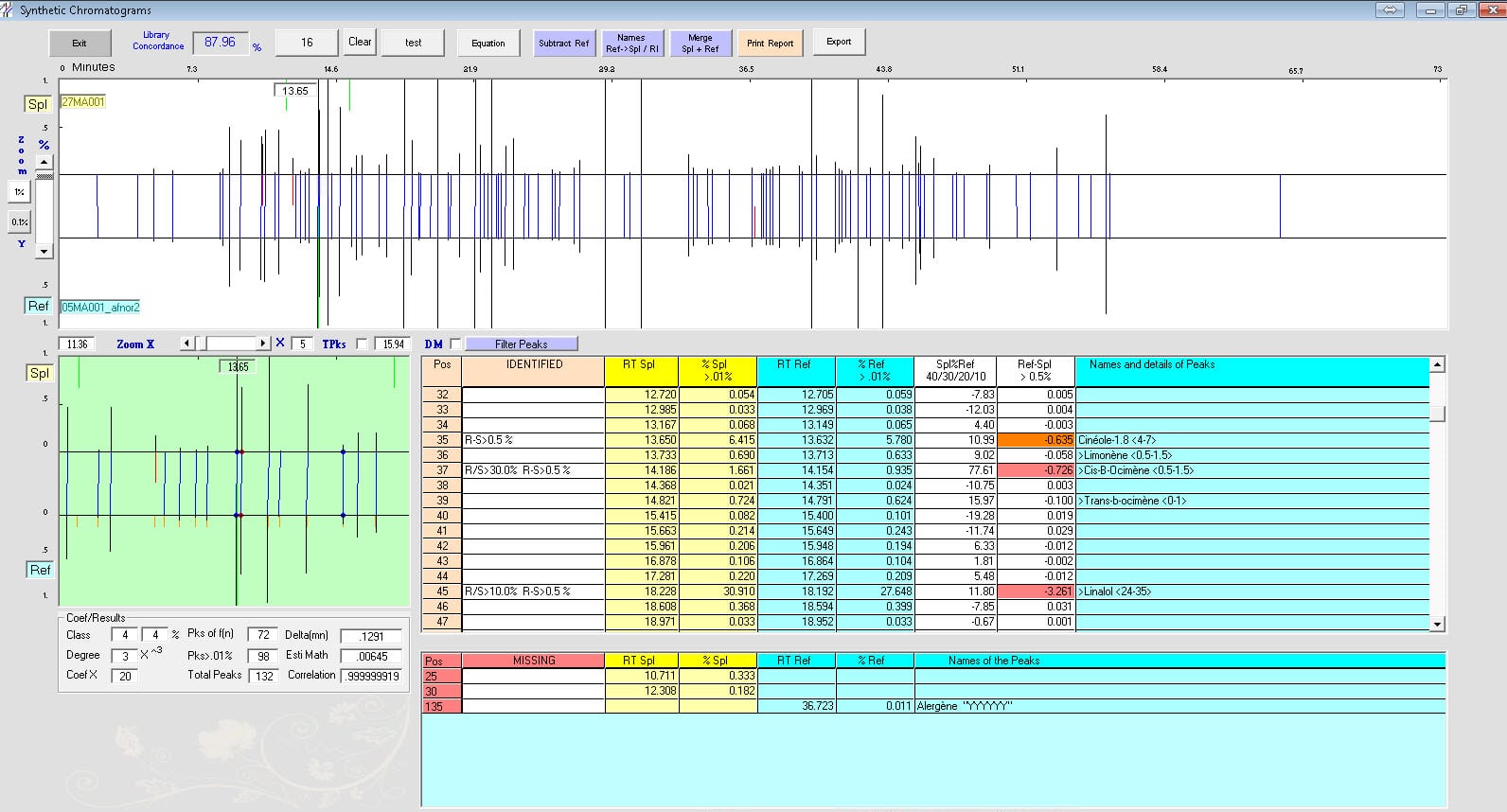
Norm compliance check on an essential oil: automatic detection of linalool, limonene, 1,8-cineole, trans-β-ocimene, etc.
The software works with every type of detector (FID, UV, TCD, ECD) without requiring a mass spectrometer. This makes it accessible to most quality control laboratories in perfumery and flavours & fragrances.
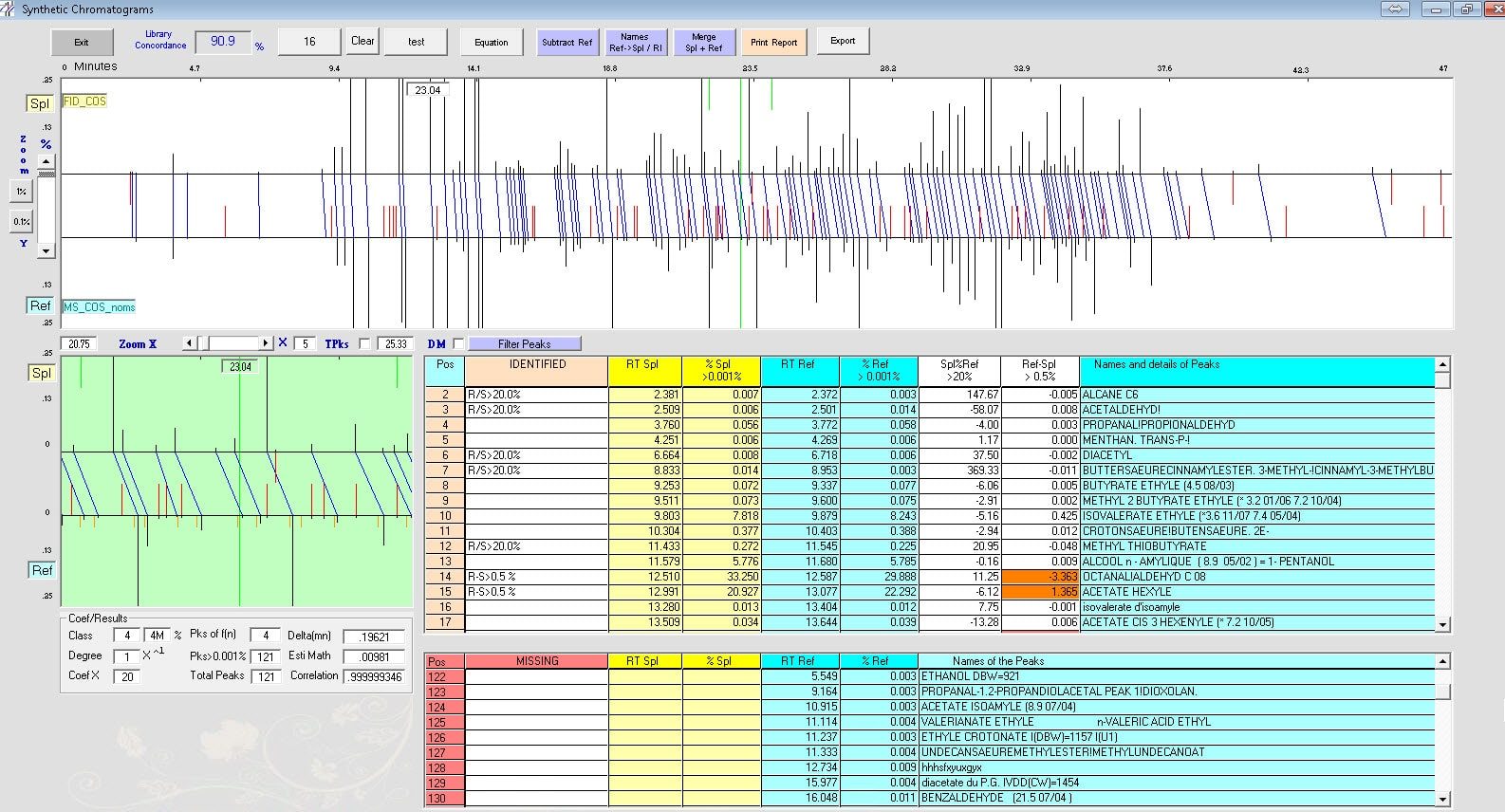
FID vs MS comparison on a food flavour: automatic identification of the components (acetaldehyde, ethyl butyrate, amyl alcohol, etc.).
Why retention times vary from one injection to the next
For the same injected product, small cumulative peak shifts (relative and absolute) appear with every new injection.
The reasons for these variations in GC and LC:
- The injection mode
- Gas or solvent flow regulation
- Temperature regulation
- Reconditioning of the chromatograph
- The chemistry of the injected product
- Impurities in the sample
- Phase oxidation (traces of O2 in the carrier gas)
- Pump precision and repeatability in HPLC
Column phase ageing varies in a non-linear, random way, depending on the injected chemicals and their concentration. Analysis after analysis, retention time shifts range from a few seconds to several minutes. When the analysed product has tens or hundreds of components a few seconds apart on the chromatogram, manual recognition is long, difficult and prone to human error.
Even a chromatograph with the latest electronic regulation of temperature and gas flow cannot compensate for these complex variations. With GC-LC Concordance, a reliable automatic analysis is now possible.
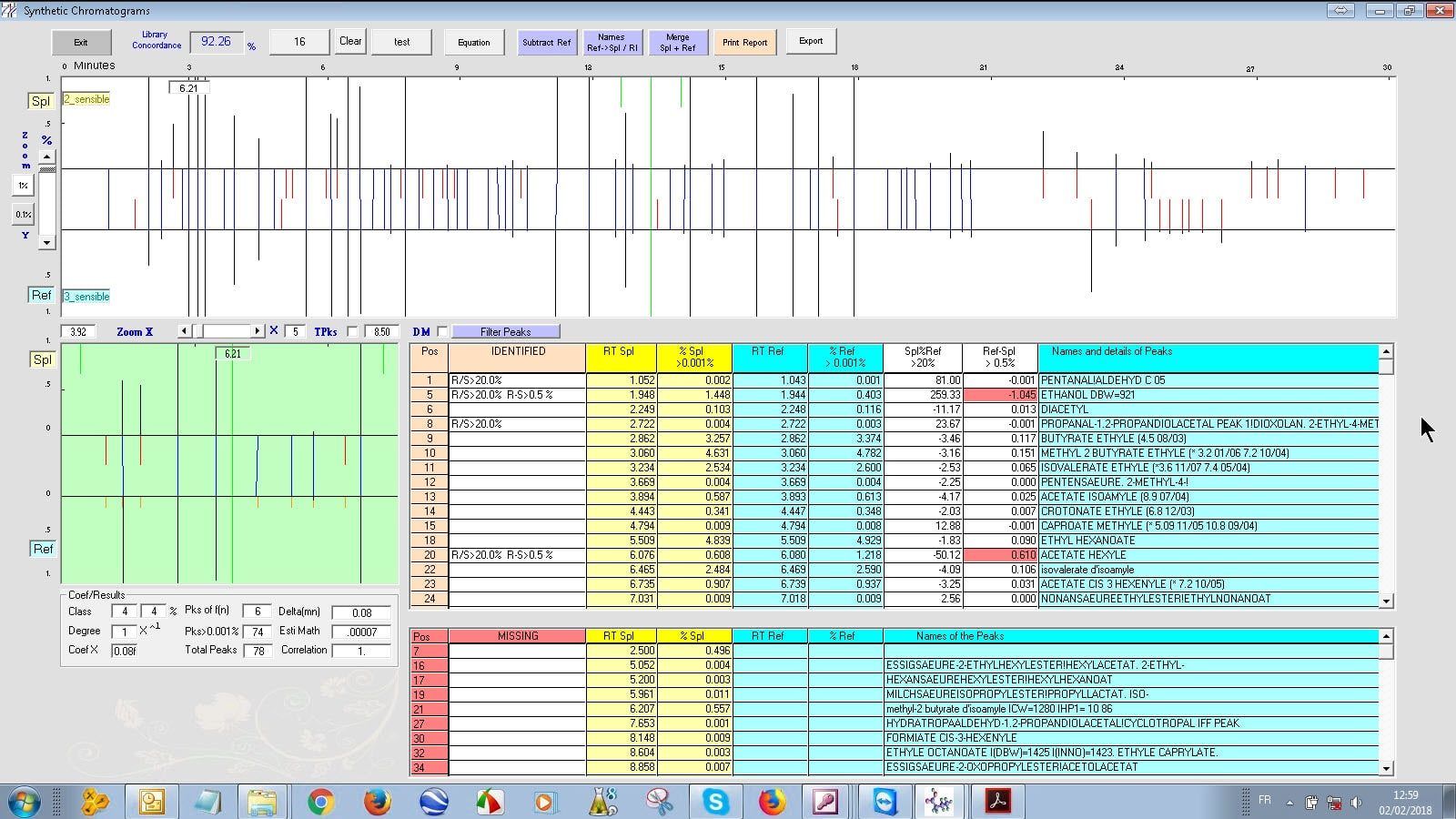
MS analysis of a complex food flavour: automatic identification and a detailed report of missing or out-of-specification peaks.
DECONVIA: deconvolution of overlapping peaks
When two molecules co-elute and their peaks overlap on your chromatogram, GC-LC Concordance cannot separate them. DECONVIA automatically deconvolutes overlapping peaks, without a mass spectrometer, and identifies each component. It works on its own or hand in hand with GC-LC Concordance.