
Improve Drastically your Productivity
- Control many more samples per day - 500 samples can be controlled automatically in one sequence!
- A much simpler calibration with a single reference.
- Reference chromatograms are saved and can be used several months, or even years later.
- You can compare, in RI, chromatograms recorded on different chromatographs and different locations.
- Increase the speed of products identification with a complete chromatographic fingerprint of the product.
- You can identify a compound of a product in RI by crossing polar and non-polar columns results and libraries of indices.
Improve Drastically your Quality Control
The control is precise, reliable and it is no longer subject to errors of comparison due to visual monitoring.
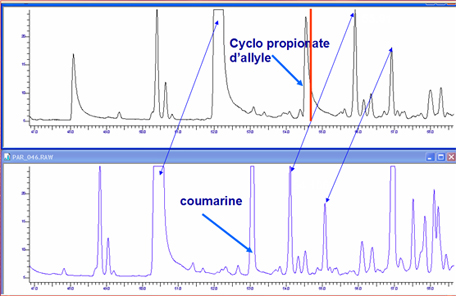
Example: Below the control of a perfumed solution compared to a reference, the zone is strongly expanded in X and Y coordinates and a retention time shifting of several minutes of the peaks does not allow to superimpose the two chromatograms.
It’s very difficult, almost impossible, for a chemist to detect that Coumarin in the reference has been replaced by allyl cyclohexyl propionate in the sample. The retention time difference of the peaks (~2 minutes in this zone) is due to environmental changes of the chromatograph (ageing of the column, gas.)
Zoom of the chromatograms “Sample/Reference” which presents an anomaly
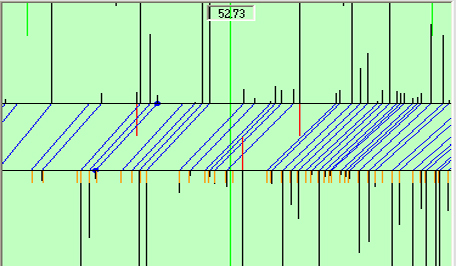
GC-LC CONCORDANCE will compensate these retention time shiftings and will detect instantaneously that the Coumarin is not in the sample and that another unknown product is there compared to the reference.
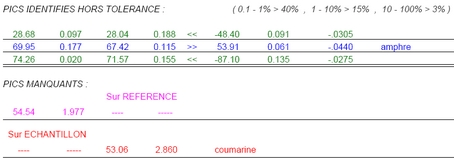
You can notice that the software reveals that three other products, present in the sample, do not correspond in concentration to the peaks of the reference (thresholds fixed by the chemist).
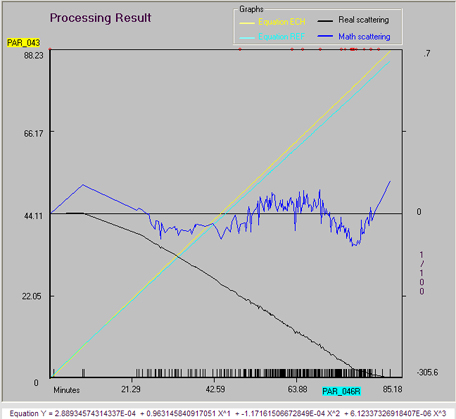
The polynomial equation calculated for the correction of peak shiftings between the two chromatograms is of order 3
Y = A0 + A1X ^ 1 + a2x ^ 2 + A3X ^ 3
It will be used to solve initial adjustment before applying random and subtle changes linked to complex variations in chromatography (repeatability of the chromatograph temperature, chemical modification of the phase in the column)